
Small Talk
You do it. I do it. Everyone does it. But why!


This story contradicts my natural instinct. If there is one thing that I have avoided as an adult, so much that I would rather have the earth split in half and consume me than me doing it is...
*drumrolls*
Making small talk.
So, I am going to analyze this behaviour and then make a case for it.
Haters, get ready to feel attacked.
Weather, Traffic, & Other Things We Pretend to Discuss Seriously
Small talk means making an informal conversation with an acquaintance or a stranger for a brief span of time on topics that are not functional or transactional. It has applications in the workplace, in waiting rooms, while travelling, at parties, etc. While all conversations are circumstantial, making small talk is a function of one’s nature. Some welcome the occasion while some would want to die instead.
The spectrum looks something like this:
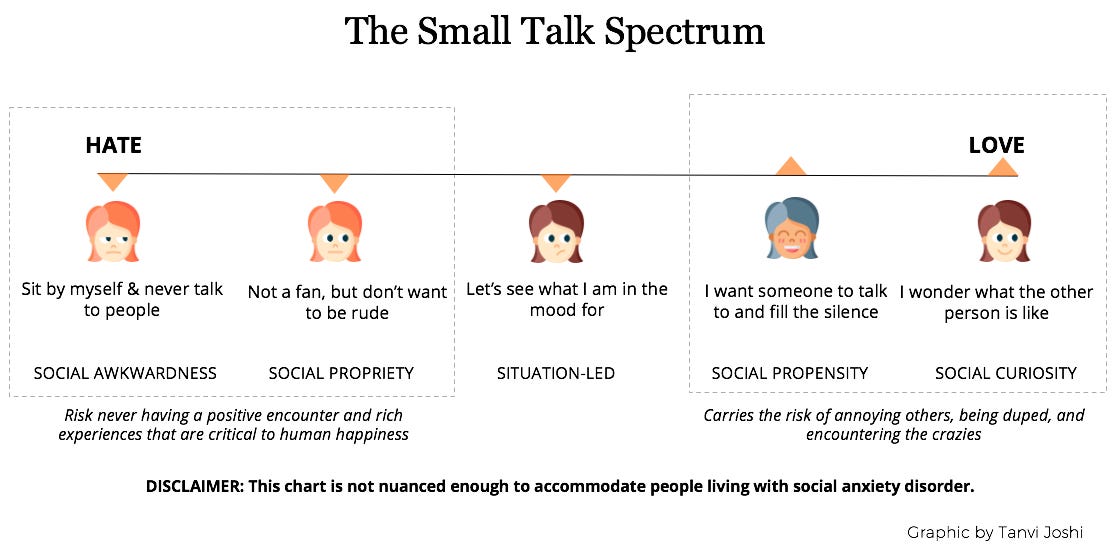
People who can small talk are deemed approachable, warm, and friendly. Even at a macro level, small talk and its cultural context reveal the social fabric of a given society (think about the French who are considered cold and standoffish and leave visitors with a bad taste).
As an individual, if you are driven by the love of small talk to keep company, your social ratings might well be high; but if genuine curiosity to learn more about the other person motivates you, count your blessings. It is a position that keeps you most exposed to serendipity.
Since this story is dedicated to the haters, let's spend time deconstructing this side of the spectrum.
This “don’t talk to me when I am wearing headphones” culture is armour against an approaching stranger. And the usual reasoning to avoid small talk is introversion or genuine disinterest.
But there is more to this resistance than plain introversion.
There are instincts at play here. That this will bore me, won’t have a positive impact on me, or the other person won’t derive any value from me, handcuffs the will to engage. That said, this behaviour largely stems from the comfort in making a snap judgement and not letting anyone challenge it. Not even yourself.
This comfort is lazy and withholds growth. But most importantly, it misses out on the opportunity to learn more about ourselves.
Ever wondered what you would say if you bumped into Humans of Bombay (or Delhi or New York) and they asked you about your life story? Of course, your life is replete with triumphs and tragedies. But when the moment presents itself, you draw a blank. There is less to say. Drawing a blank on occasions like these is a result of limited opportunities for introspection and not practising speech with the unknown.
Talking to strangers engages muscles and habits that are least developed. It challenges you to change course from well-worn paths you take with family or childhood friends (because you already know their likes and dislikes) and venture into newer territories.
As a researcher, when I encounter respondents that are closed off, I engage them using my Small Talks Cheat Sheet. I have made a Venn Diagram (obviously) that can help you gain richer insights from strangers.
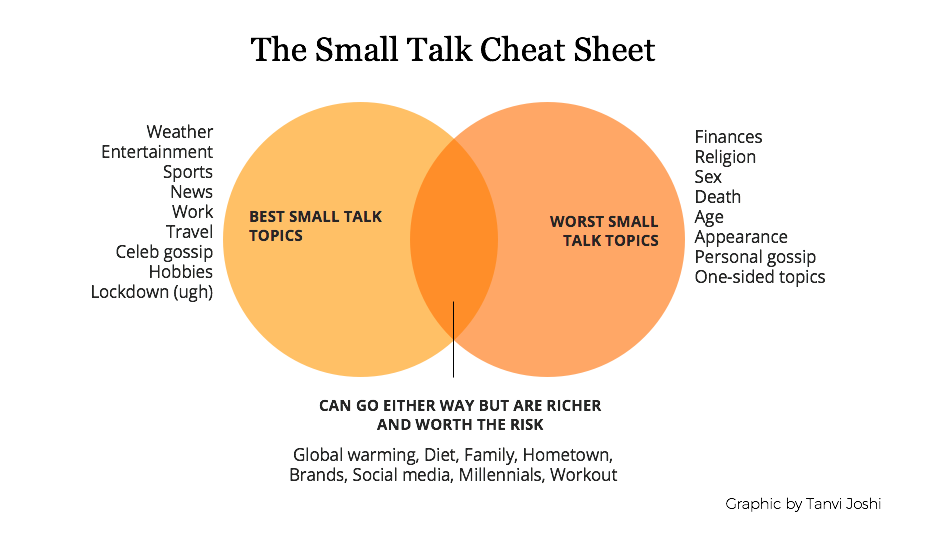
While I make attempts to stop being the woman who does pretend phone calls just to avoid a conversation (sometimes even at home), tell me where you fall on the Small Talk Spectrum.